What Should Happen After a Patient Accepts a Treatment Plan
The hardest part of treatment, the decision, has already happened. The gap between a yes and an appointment is the most expensive one in the journey.
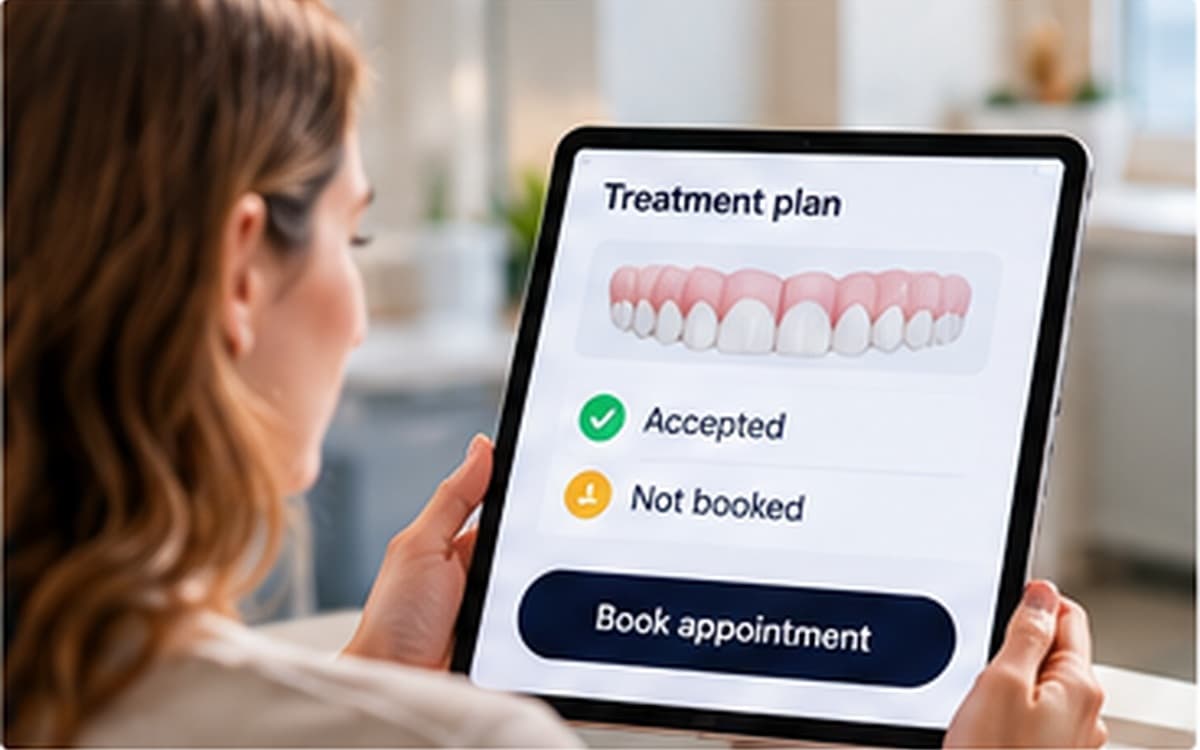
The hardest part of treatment, the decision, has already happened. The gap between a yes and an appointment is the most expensive one in the journey.
The gap nobody measures
Practices measure acceptance. Fewer measure what happens next. A patient agrees to treatment on the phone, at the desk or in a message, and the plan is marked as accepted. The appointment that should follow is meant to be booked “once the lab is sorted” or “when the patient confirms a date”.
Weeks later the plan still reads as accepted, and nobody has noticed that the patient was never booked in. This is the most expensive gap in the treatment journey, because the hardest part, the decision, has already happened.
Keep accepted and booked as two different states
The fix starts with language. If “accepted” means the patient agreed and “booked” means an appointment exists, the gap becomes visible: any plan that is accepted but not booked is a piece of work with an owner.
If a single status covers both, the gap is invisible by design.
What should happen in the first 48 hours
Once a patient has said yes, the practice should aim to have a booking within two working days.
- Confirm which treatment was accepted, and how long the first appointment needs.
- Check whether a deposit or payment plan applies, and how the patient will pay it.
- Offer the patient specific times, not an invitation to ring.
- Book the appointment and link it to the plan, so the plan reads as booked.
- If the appointment is later cancelled, put the plan back to accepted, not booked, so it reappears.
Why the cancellation step matters
A booked first appointment that is cancelled and never rebooked is the same gap arriving by a different route. A practice that only checks for accepted plans without an appointment will miss every plan whose appointment was cancelled afterwards.
Why it happens so often
Accepted plans go unbooked for ordinary reasons, which is why the gap is so common.
- The patient says yes on the phone while reception is with someone else, and the call ends without a booking.
- The first appointment depends on something outside the practice: a lab, a referral, a payment plan approval.
- The treatment needs a longer appointment than the diary has free this month, and the conversation moves on.
- The patient agreed in principle and wanted to “check dates”, and nobody followed up.
Questions to ask your own diary this week
If you want to know how big the gap is at your practice, it takes an hour.
- List every treatment plan accepted in the last three months.
- For each, check whether a first treatment appointment exists in the diary.
- For each without one, note the reason, if anyone knows it.
- Give each unbooked plan an owner and a date by which it will be booked or closed.
How Clinqly handles it
Clinqly keeps accepted and booked separate. When a plan is accepted and has no appointment, it appears in Today with real times for that treatment. A person confirms the service and sends the patient a booking link for those times; a booking made through the link is matched to the plan, and if that appointment is cancelled the plan comes back to Today on its own.
Clinqly does not book the appointment for the patient without them, and it does not claim to know whether treatment went ahead. It makes sure an accepted plan cannot quietly sit unbooked.