Can AI Safely Answer Dental Patient Questions?
The useful question is not whether AI can answer patients safely, but which questions. A safe system knows the difference every time.
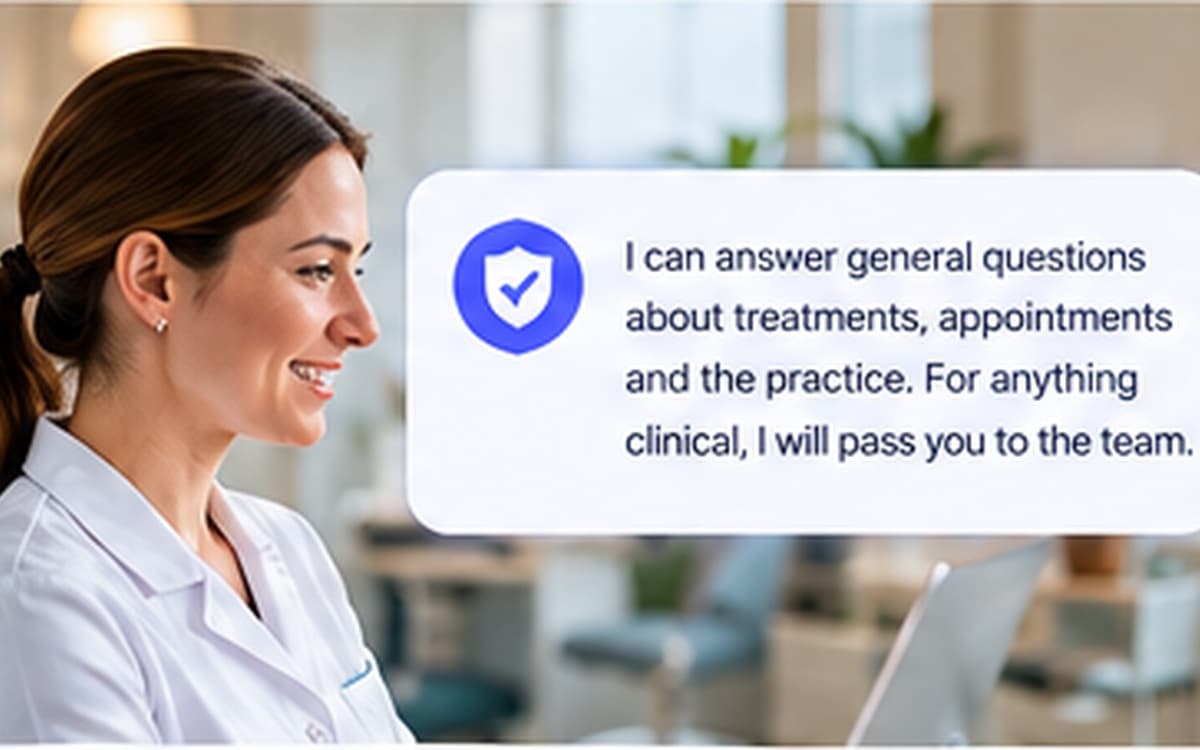
The useful question is not whether AI can answer patients safely, but which questions. A safe system knows the difference every time.
The right question is which questions
Asking whether AI can safely answer patient questions is too broad to answer. Some questions are safe for software to answer from information the practice has approved: opening hours, parking, the price of a hygiene appointment, whether the practice offers aligners. Others are not, and never will be: whether a symptom is serious, whether a patient is suitable for implants, what a photo of a tooth shows.
A safe system is one that knows the difference, every time.
Three kinds of patient question
- Practice facts: hours, location, prices, treatments offered, how booking and deposits work. Safe to answer from approved information.
- Process questions: how to rebook, whether a deposit is refundable, what to bring. Safe when the practice has written the answer down.
- Clinical and personal questions: symptoms, pain, suitability, outcomes, medication, anything involving a photo. Always for a person.
What makes an AI receptionist safe
When you evaluate any system, ask for evidence of each of these rather than a general assurance.
- It answers only from information your practice approved, not from the open internet.
- It says when it does not know, instead of guessing.
- It never interprets symptoms or gives clinical advice, and hands those conversations to a person.
- It tells patients who to contact in an emergency, on every channel.
- It tells patients they are speaking to a virtual receptionist.
- Your team can read every conversation and take over at any point.
Who is responsible for the data
For the enquiries patients send, the practice is normally the data controller and the software provider the processor. Ask each vendor where data is held, which sub-processors it uses and what written terms it offers, and involve whoever handles data protection at your practice before going live.
A worked example: a question that looks simple
A patient messages: “How much is a filling? I've got a bit of pain on the left side.” The first half is a practice fact; the second is clinical.
A safe reply answers the price from the practice's approved fee information, does not comment on the pain, and makes sure a person picks the conversation up, with a clear note on what to do if the pain gets worse or the patient needs urgent help. An unsafe reply guesses at the cause, reassures the patient or suggests they can wait.
Testing a system before you trust it
Before going live with any AI receptionist, spend half an hour trying to break it. Ask clinical questions in everyday language, ask about prices you have not given it, ask whether you are talking to a person, and send a message that mixes a booking request with a symptom. Every one of those should end with either an approved answer or a clear handover.
How Clinqly handles patient questions
Clinqly answers from the information the practice approved and says when it does not know. It never interprets symptoms or offers clinical advice: it records what the patient said for the clinician and hands the conversation to a named person with the context attached. Emergencies are signposted to the practice on every channel, patients are told they are speaking to the practice's virtual receptionist, and the team can read every conversation and take over at any time.